EXPERT TALK (SHED): Global Sports Innovation (GSI) – Tsukuba Campus – June 29th, 2026
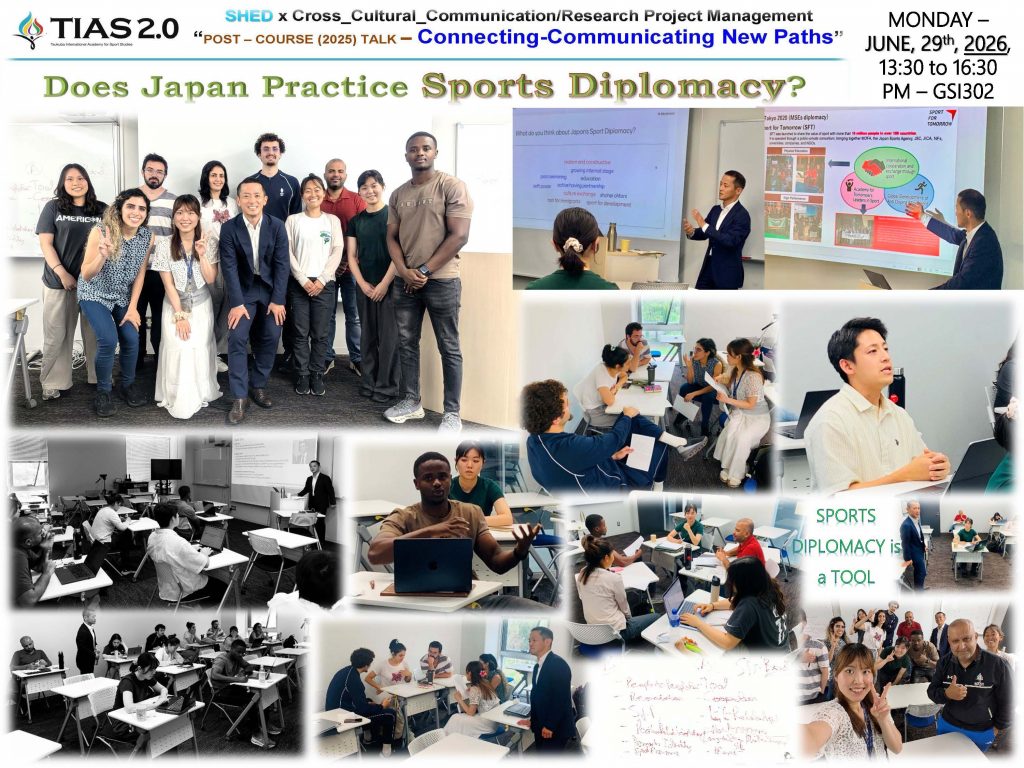
On 29 June, TIAS2.0 (Prof. Randeep Rakwal, Institute of Health and Sport Sciences; under the SHED international platform) welcomed Mr. Sho Sato, Public Relations Researcher at the Ministry of Foreign Affairs of Japan, whose professional experience spans sport policy and international sport cooperation, to conduct a workshop on sport diplomacy.
TIAS aims to cultivate both a global perspective, enabling students to understand the rapidly changing international environment, and a local perspective, developed through learning from communities across Japan. In this workshop, participants (TIAS2.0 6th batch, including IDS) had the opportunity to deepen their understanding of sport diplomacy through Mr. Sato’s practical insights into sport policy and international sport cooperation.
During the first half of the workshop, participants explored major theories of International Relations and their application to sport. They also examined Japan’s sport diplomacy by referring to key domestic frameworks, including the Basic Act on Sport and the Basic Sport Plan. Through these discussions, participants gained a deeper understanding of the various actors involved in Japan’s sport diplomacy, their respective roles, and the relationships through which sport diplomacy initiatives are implemented. The workshop also examined contemporary case studies, including the ongoing 2026 FIFA World Cup and the Tokyo 2020 Olympic and Paralympic Games. Through these examples, participants explored both the diplomatic significance and the challenges associated with major international sporting events from theoretical and practical perspectives.
In the second half of the workshop, participants reflected on their own countries and areas of interest through the lens of diplomacy. By combining individual reflection with group discussions, they learned from one another and gained a deeper appreciation of the role that sport can play in international relations and international cooperation; i.e., sport cross-cultural communication.
Looking ahead, TIAS will continue to provide students with opportunities to engage with leading practitioners and researchers from around the world, fostering both global and local perspectives as it prepares the next generation of leaders in international sport.